
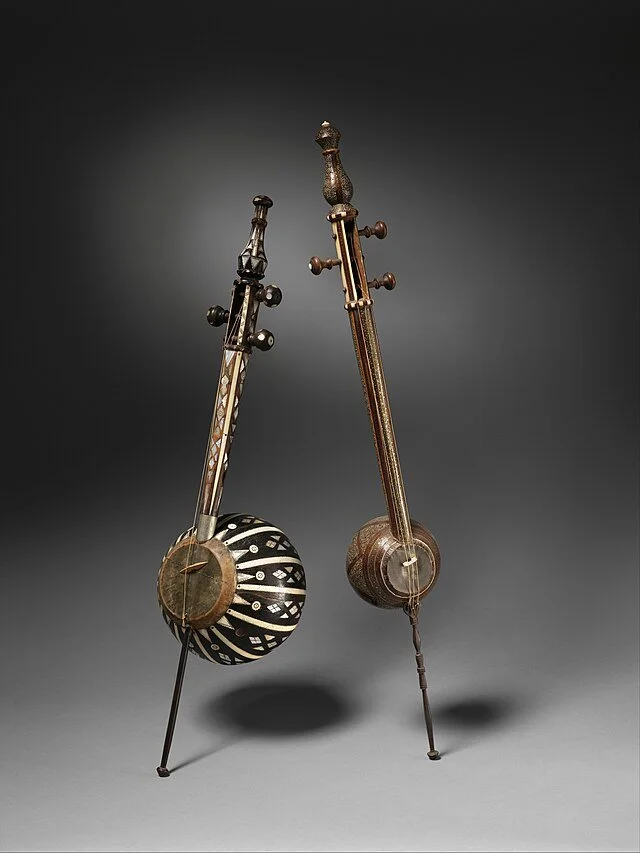
Two Kamānche
This thing called “America” says it is celebrating its 250th birthday. What was birthed? What is being celebrated? Maybe as some persistent afterbirth, a putrid excrescence has formed as an expression of American character, economy, power and rulership (surely not leader-ship). In the form of a tumor vomited forth in 1946, this infantile America now rains slaughter upon cultures, traditions, poetries, maqam and tasnif (Arabic and Persian musical modes). An infant too full of hubris and idiocy to recognize the vast span of voices speaking from ancestors familiar with epochs of imperial violences while intimate with the ecstasies of love, grief, and as the recipients of the gift we call life.
This morning my music library randomly began to play the immense delicacy and beauty of Kayhan Kalhor, a poet of sorrow and passions on the ancient kamānche, ancestor to the violin from Persian culture. There’s something that speaks directly to the heart in the raspy kamānche’s voice, a timbre speaking to thousands of years of acquired heartbreaks, wisdom, love, and godly transcendence. Kalhor’s delicacy of phrasing, his dynamic ascents that come down to a whisper, his minute shifts of intonation, of timbre, of emotion all in a single sustained note as his bow draws across the string are inheritances of voices still speaking through ancient gushehs of the Persian dastgah and Kalhor’s fingers of sedimented beauty. Kalhor joins his kamānche’s ancestral embodiment with singers such as Mohammed Reza Shajarian, with a Malian kora with Toumani Diabate, as the Ghazal Ensemble with Indian sitar musician Shujaat Husain Khan, with string quartets Brooklyn Rider and Kronos, and more.
I can’t help but hear the ancestral voice of Rumi’s poetry as I listen to Kalhor, where Rumi says,
All day I think about it, then at night I say it.
Where did I come from, and what am I supposed to be doing?...
My soul is from elsewhere, I’m sure of that,
And I intend to end up there.
And I have to ask, what kind of world is this? By what right? Is this truly what it all boils down to, this Hobbesian desecration of war of all with all?
…but who is it now in my ear who hears my voice?
Who says words with my mouth?
Who looks out with my eyes?
And we’re forced to watch as the worst with the most, ensconced in their violent idiocy – keeping in mind this word’s Greek origin, idios (of the self) – an arrogant self-imposed insulation of circular babble with oneself, deaf to others, to ancestral idioms of wisdom and hospitality to the stranger/other, deaf to the mystery of being the beholden recipient of life and creation, only to insert one’s lethal idiocy and venality as the only voice worth listening to.
…I didn’t come here of my own accord, and I can’t leave that way.
Whoever brought me here will have to take me home.
It’s astounding to see the juxtaposition of the Midas-of-Shit evacuate the bowels of his mouth, “My own morality. My own mind. It's the only thing that can stop me," trapped in the stupidity of his circular idios-y. 79 year old, 250 year old arrogating infantile hubris against 2600 years, Rumi’s recitations, Kayhan Kalhor’s kamānche.
And so we witness the shaking of our world and planet, each teetering on the precipice of ending life as we know it on Earth because there are those who think they came here of their own accord and will decide who and how they will leave. Ancestors annihilated amidst the industrial production of corpses. Voices of those who would nourish life ongoing in their dying versus death as commodity that feeds nothing and leaves life starved and emaciated.
These are the times we live in and witness.
These are the needed conversations of sanity. We need both the deep listening to land and ancestors while willing to voice our accountabilities and complicities. We may even need to voice how we might die to feed what might come after. This is how it works, an ancestor’s voice from 800 years ago still nourishes us, the living,
God has revealed to me that there are no rules for worship.
Say whatever and however your loving tells you to.
Your sweet blasphemy is the truest devotion.
Through you a whole world is freed.
Noël, Aláwo Orísàn